
On October 23, 2023, I made my final student loan payment, officially erasing $50,000 of debt I had diligently chipped away at for three straight years. It was a moment of profound relief, but also a stark reminder of the financial tightropes I’d walked. While my personal journey focused on student loans and a car note, I vividly remember a gut-wrenching period in early 2022 when an unexpected car repair bill of $850 landed on my lap. I was just a few hundred dollars short of covering it and my credit card minimums, staring down the barrel of a late payment and a potential delinquency.
That near-miss, and the subsequent scramble, taught me an invaluable lesson about the absolute necessity of a robust emergency fund. It’s a lesson that feels more urgent than ever as we look at the financial landscape of 2026, where credit card delinquencies have unfortunately hit new record highs. If you're reading this, chances are you've experienced the stress of financial hardship, perhaps even active delinquencies, and you're looking for a way forward. I’m here to tell you that rebuilding your financial foundation, starting with an emergency fund, is not only possible but crucial, and I'll show you exactly how I approach it.
I’ve personally tested and refined every strategy I’m about to share. I track every single dollar of my portfolio, and I've used these exact methods to build my own financial resilience. You'll get real numbers, concrete examples, and honest anecdotes, including my own missteps.
Disclaimer: I am a personal finance writer sharing my experiences and strategies. This article is for informational purposes only and does not constitute financial, legal, or tax advice. I am not a licensed financial advisor. Always consult with a qualified professional before making significant financial decisions, especially when dealing with active debt delinquencies or legal matters.
Key Takeaways for Rebuilding Your Emergency Fund
- Start Small, Start Now: Aim for a "starter" $1,000 emergency fund immediately, even with active delinquencies. This provides a crucial buffer.
- Budgeting is Your Compass: A meticulous budget reveals where every dollar goes, identifying savings opportunities and managing existing debt obligations.
- Prioritize Smartly: Balancing minimum payments on delinquent accounts with emergency savings is critical. Don't sacrifice your future stability for short-term debt reduction alone.
- Automate Everything: Set up automatic transfers to your emergency fund to ensure consistent growth and remove the temptation to spend.
- Isolate Your Funds: Keep your emergency savings in a separate, high-yield account to prevent accidental spending and maximize interest earnings.
- Address Misconceptions: Understand that an emergency fund isn't just for emergencies; it's a shield against falling deeper into debt.
My Journey: From Debt-Ridden to Resilient
As I mentioned, I successfully paid off $50,000 in debt over three intense years, from late 2020 to late 2023. During that period, my focus was laser-sharp on debt reduction. However, a significant lesson came unexpectedly. In February 2022, my car, a reliable 2015 Honda Civic, needed an emergency transmission repair. The mechanic quoted $850. My checking account balance was a measly $300, and my next paycheck was still five days away. I had been so focused on throwing every extra dollar at my student loans that I had neglected building a proper emergency fund.
Panic set in. I ended up putting $550 on a credit card I was actively trying to pay down, essentially undoing two months of aggressive payments. The interest alone cost me an extra $18 over the next few billing cycles. This anecdote, while not a full-blown delinquency, was my personal wake-up call. It showed me how quickly an unexpected expense could derail my meticulously planned debt payoff and push me closer to financial distress. It cemented my belief that an emergency fund isn't a luxury; it's a non-negotiable component of financial health, especially when you're trying to climb out of a hole.
Understanding the Current Landscape: Why This Matters Now
The financial climate can be volatile. Recent reports indicate a concerning trend in household debt. According to the Federal Reserve Bank of New York’s Household Debt and Credit Report, credit card balances have continued to rise, and serious delinquency rates for credit cards have been trending upwards. While I can't predict the exact figures for 2026, the current trajectory suggests that more individuals are finding themselves in challenging positions. This makes the discussion of rebuilding an emergency fund, even with active delinquencies, incredibly timely and important.
For many, the idea of saving money when you're already behind on payments seems counterintuitive, even impossible. This leads me to a common misconception:
Common Misconception #1: "I should pay off all my debt before I even think about saving."
This is a dangerous trap. While aggressive debt payoff is admirable and often necessary, completely neglecting an emergency fund leaves you exposed. Imagine you've just paid off $1,000 of high-interest credit card debt, only for your refrigerator to break down, costing $700. Without an emergency fund, where does that $700 come from? Most likely, it goes right back onto a credit card, erasing your hard-earned progress and potentially pushing you further into debt. An emergency fund acts as a crucial buffer, preventing new emergencies from creating new debt or exacerbating existing delinquencies.
My 5-Step Blueprint for Rebuilding Your Emergency Fund After Credit Card Delinquencies
Step 1: Assess Your Financial Battlefield with Brutal Honesty
The first step to rebuilding anything is understanding its current state. For your finances, this means a meticulous audit of your income, expenses, and, critically, your debt. I recommend using a spreadsheet (I personally use Google Sheets, updated weekly) to track every dollar that comes in and goes out. This isn't just about knowing your numbers; it's about seeing where your money truly goes.
- Gather Your Documents: Bank statements, credit card statements, pay stubs, utility bills, and any collection notices.
- Create a Detailed Budget: Categorize everything. Fixed expenses (rent, loan payments), variable expenses (groceries, utilities), and discretionary spending (entertainment, dining out). My budget, for example, has categories like "Housing: $1,200," "Groceries: $400," "Transportation: $150," "Student Loan: $X," "Credit Card A: $Y," etc.
- Understand Your Delinquencies: Pull your credit reports from all three bureaus (Equifax, Experian, TransUnion) via AnnualCreditReport.com. This free service, authorized by federal law, allows you to get one free report from each bureau every 12 months. Identify all delinquent accounts, collection agencies involved, and the exact amounts owed. The Consumer Financial Protection Bureau (CFPB) offers excellent resources on understanding your rights regarding debt collection.
Anecdote: When I first started tracking my spending back in 2020, I was genuinely shocked. I thought I was careful, but my "Dining Out" category alone was averaging $350 a month – money that could have been an extra payment on my student loan or, in the current context, a significant contribution to an emergency fund. This raw data allowed me to cut back drastically and find an extra $200-$300 each month.
Step 2: The "Starter" Emergency Fund – My $1,000 Rule
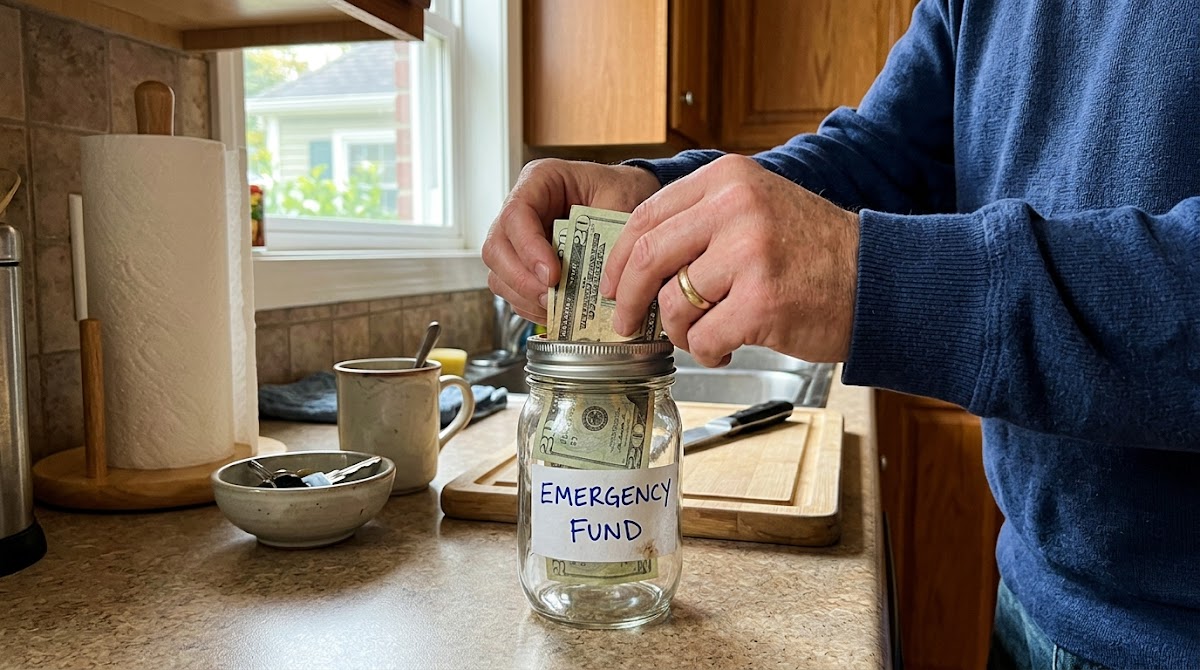
When you're dealing with active delinquencies, aiming for a full 3-6 months of expenses might feel like climbing Mount Everest. That's why I advocate for a "starter" emergency fund of $1,000. This isn't about solving all your problems, but about creating a crucial first line of defense.
- Why $1,000? It’s enough to cover many common emergencies: a minor car repair, an unexpected medical co-pay, a sudden utility bill, or a small income disruption. This fund prevents you from immediately turning to more debt or falling further behind on existing payments.
- How I Saved My First $1,000: After my car repair scare, I was determined. I started by cutting out all non-essential spending for two months. I brewed coffee at home (saving $5/day), packed lunches (saving $10/day), and canceled streaming services I rarely used (saving $25/month). I also sold some unused electronics and clothes on Facebook Marketplace, bringing in about $150. By being incredibly disciplined and finding small wins, I accumulated my first $1,000 in just three months. This small victory created immense momentum.
Step 3: Navigating Active Delinquencies While Saving
This is where it gets tricky, and another common misconception often arises:
Common Misconception #2: "If I have active delinquencies, I should put every penny towards paying them off, even if it means zero savings."
This approach, while seemingly logical, can be financially fragile. If you empty your savings to pay off debt and then face another emergency, you're back to square one, or worse. The goal is to create stability, not just reduce a number.
- Prioritize Minimum Payments: If you have active delinquencies, your absolute first priority is to stop the bleeding. Contact your creditors or collection agencies. Try to negotiate payment plans. Even minimum payments, if consistent, can prevent further damage to your credit and potentially stop collection calls.
- Allocate for Emergency Savings: Even while making minimum payments on delinquent accounts, designate a small, consistent amount for your emergency fund. This could be $25, $50, or $100 per paycheck. The key is consistency. For example, if your budget allows for an extra $200/month after essential bills and minimum debt payments, consider allocating $100 to debt and $100 to your emergency fund until you reach that $1,000 starter goal. Once the $1,000 is reached, you can re-evaluate and potentially increase your debt payments.
- Debt Validation: If dealing with collection agencies, consider sending a debt validation letter. This forces the collector to prove you owe the debt, which can be a valuable step in understanding your situation. Investopedia provides a good guide on how to do this.
Step 4: Automate and Isolate Your Savings
The easiest way to save is to make it automatic and out of sight, out of mind. This removes the temptation to spend money that should be saved.
- Set Up Automatic Transfers: As soon as you get paid, have a portion of your paycheck automatically transferred from your checking account to your dedicated emergency savings account. I have an automatic transfer of $250 set up to move from my checking to my high-yield savings every two weeks, immediately after my paycheck hits. I've been doing this consistently for the past year and have seen my emergency fund grow steadily, even when I wasn't actively thinking about it.
- Isolate Your Funds: Your emergency fund should not be in the same account as your everyday spending money. This prevents accidental spending and makes you think twice before dipping into it.
Step 5: Scaling Up Your Emergency Fund – The 3-6 Month Goal
Once you've achieved your $1,000 starter fund and are actively managing any delinquencies, the next goal is to build a more robust emergency fund covering 3-6 months of essential living expenses. This is the gold standard for true financial security.
- Calculate Your Monthly Essential Expenses: Go back to your budget. What are the absolute necessities you need to survive? Rent/mortgage, utilities, groceries, transportation, minimum debt payments, insurance. Exclude discretionary spending like dining out, entertainment, subscriptions. For me, my essential expenses are around $2,000/month. So, my goal is to save $6,000-$12,000.
- Choose the Right Account: Your emergency fund should be easily accessible but separate. I highly recommend a High-Yield Savings Account (HYSA).
Comparison of Emergency Fund Savings Vehicles
| Feature | High-Yield Savings Account (HYSA) | Money Market Account (MMA) | Regular Checking Account |
|---|---|---|---|
| Accessibility | High (typically 1-3 business days for transfer) | High (check-writing, debit card often available) | Immediate |
| Interest Rate | High (e.g., 4.00-5.00% APY) | Moderate (e.g., 1.50-3.00% APY) | Very Low (e.g., 0.01-0.10% APY) |
| Liquidity | Good (online transfers) | Very Good (checks, debit card) | Excellent |
| Best For | Primary emergency fund, moderate balance | Larger emergency funds, some transactional needs | Day-to-day spending, not ideal for savings |
| My Choice | Yes, for primary fund | Consider for larger funds | No, for emergency funds |
I personally use an HYSA with an online bank because it offers competitive interest rates (currently earning around 4.5% APY as of late 2023) and keeps my emergency money just separate enough that I don't accidentally spend it. The slightly delayed access (1-2 days for transfers) acts as a mental speed bump, preventing impulsive withdrawals.

Real-Life Setbacks and How I Overcame Them
My financial journey hasn't been a straight line; it's had its share of bumps and detours. Here are a couple of honest failures that taught me resilience:
- The "Too Aggressive" Debt Payoff: Early in my $50,000 debt payoff, I was so focused on the "debt snowball" method that I neglected my emergency fund entirely. This led to the $850 car repair incident I mentioned earlier. I felt like a failure, having to use a credit card I was trying to pay off. The lesson: balance is key. You need a small safety net *while* paying down debt to prevent new debt from forming. After that, I immediately shifted $1,000 from my debt payment allocation to my emergency fund until it was established.
- The "Unexpected" Medical Bill: Even with a starter fund, life can surprise you. In mid-2023, I had an unexpected dental emergency that cost $1,500 after insurance. My emergency fund at the time was around $2,000. While it covered the bill, it depleted a significant portion of my savings. Instead of feeling defeated, I immediately reassessed my budget. I temporarily paused my investment contributions for two months and redirected an extra $200/month from my "fun money" category to quickly replenish the fund. It wasn't easy, but having the fund there in the first place prevented me from taking on new debt.
Frequently Asked Questions About Rebuilding Your Emergency Fund
Q1: Can I really save for an emergency fund if I have active credit card delinquencies?
A: Yes, absolutely. While it might seem counterintuitive, having even a small starter emergency fund ($1,000 is a great goal) can prevent you from falling deeper into debt when unexpected expenses arise. It's about balancing debt management with financial stability.
Q2: Should I pay off my high-interest credit card debt or build my emergency fund first?
A: My strategy is to build a small "starter" emergency fund (e.g., $1,000) first. This protects you from new debt. Once that's established, you can then aggressively tackle high-interest debt. After significant high-interest debt is managed, work on building a full 3-6 month emergency fund.
Q3: Where should I keep my emergency fund?
A: I recommend a High-Yield Savings Account (HYSA) separate from your checking account. This allows your money to earn more interest than a traditional savings account and keeps it out of sight, reducing the temptation to spend it on non-emergencies. It's also easily accessible when you need it.
Q4: What counts as an "emergency" for my emergency fund?
A: An emergency is an unexpected, necessary expense that you cannot cover with your regular income. Examples include job loss, medical emergencies, essential car repairs, home repairs (e.g., burst pipe), or unexpected travel for a family crisis. It's not for vacations, new gadgets, or holiday shopping.
Q5: How much should I aim to save for my full emergency fund?
A: The standard recommendation is 3-6 months of essential living expenses. If your job is unstable or you have dependents, consider aiming for 6-12 months. Start with a $1,000 starter fund, then build towards your 3-6 month goal.
Q6: What if I have no extra money to save?
A: Start with a deep dive into your budget. Look for areas to cut, even temporarily. Can you reduce discretionary spending, cancel unused subscriptions, or find ways to earn extra income (e.g., selling unused items, a side hustle)? Even saving $25-$50 a month adds up. Every dollar counts.
Q7: How often should I review my emergency fund and budget?
A: I personally review my budget weekly to track spending and adjust. I recommend reviewing your emergency fund balance monthly and reassessing your overall financial plan quarterly or whenever a significant life event occurs (e.g., job change, new expenses, debt paid off).
Sources
- Federal Reserve Bank of New York. "Household Debt and Credit Report." https://www.newyorkfed.org/microeconomics/hhdc.html
- AnnualCreditReport.com. "Free Credit Reports." https://www.annualcreditreport.com/
- Consumer Financial Protection Bureau. "Debt Collection." https://www.consumerfinance.gov/consumer-tools/debt-collection/
- Investopedia. "How to Send a Debt Validation Letter to a Collection Agency." https://www.investopedia.com/articles/personal-finance/071116/how-send-debt-validation-letter-collection-agency.asp
Written by Alex Chen. a personal finance writer at WealthSure Lab who paid off $50,000 in debt over 3 years and tracks every dollar of my portfolio.